
Result release with agent assistance
Reducing provider workload by introducing a virtual assistant that streamlines how genetic test results are delivered to patients.
Team
1 UI/UX Designer
1 Software Engineer
1 Product Manager
My role
UI/UX Designer
Devices
Desktop & Mobile
Timeframe
6 months
PROJECT
A virtual assistant, Gia, was newly introduce to Invitae’s services to support providers and patients on their genetic testing journey. My team’s focus on this project was assisting the provider by streamlining the result delivery process through customization of result release.
GOAL
Onboard providers to a customization of report release by implementing intuitive components and building trust with the use of a virtual agent.
MY CONTRIBUTION
I owned end-to-end design — research synthesis, information architecture, wireframes, high-fidelity UI, and usability testing across both platforms.
The problem
Providers were the gatekeepers for every genetic test result (positive, negative, and carrier) and manually reading through each patient's results before deciding how to deliver them. This was slow, and it left no clear path for handling routine, lower-urgency results without pulling provider time away from patients who needed it most.
Invitae introduced Gia, a virtual assistant, to help close that gap. My team's job was to design how providers would configure and trust Gia to take on part of that delivery process.
Key insight
Early research showed the existing settings page was cluttered with low-value customization — "Amended reports" and "Report settings" were used by under 4% of providers. We could strip out what wasn't working and use the reclaimed space to introduce Gia as a real option, not a buried feature.
We also learned providers didn't want a one-size-fits-all handoff. Power users wanted tight control over urgent results (positive, carrier) where timing and delivery mattered. But for lower-urgency results, especially negative ones, many providers were open to letting Gia handle the delivery in a way that still felt considerate to the patient.
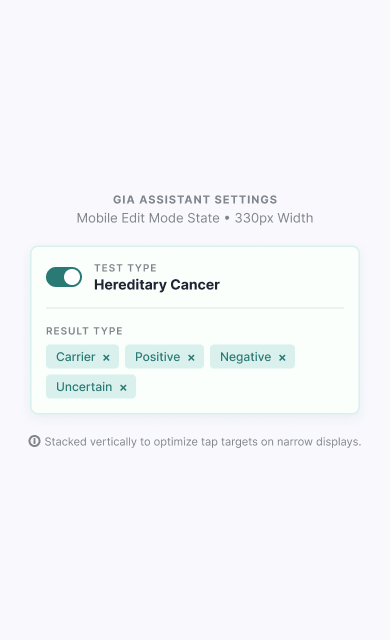
DESIGN DECISIONS: DESKTOP
I restructured the settings information architecture so manual customization and Gia sat side-by-side as equally valid choices, rather than defaulting providers into the old manual flow. Result types were ordered by clinical severity based on provider interviews, so the most urgent cases were never buried.
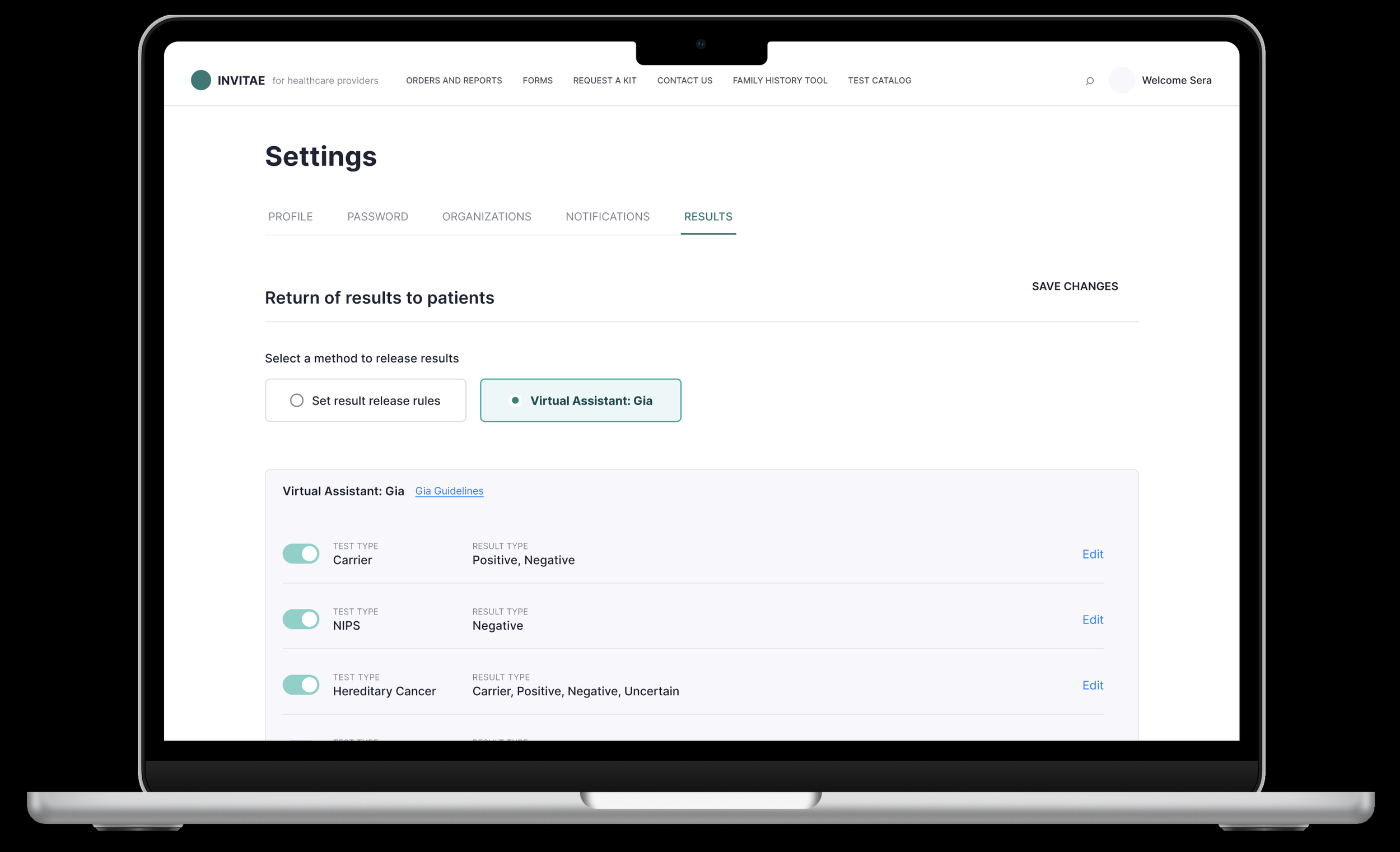
PROTOTYPE TESTING: MOBILE
Rather than mirror the desktop layout, I moved Gia setup into its own page flow and hid result-type detail behind an explicit "Edit" state. Providers were mostly desktop-first, but mobile still needed to work without overwhelming a smaller screen with every control at once.
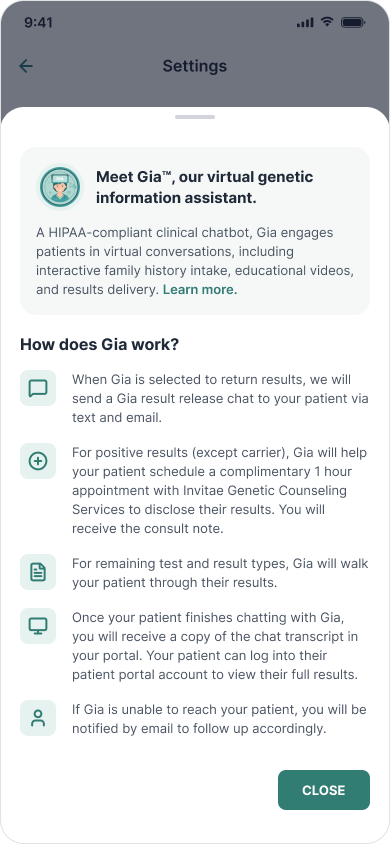
Building Trust with Educational Content
Initial adaptation of Gia required trust. I worked with the Marketing team to produce an easily accessible introductory modal. Utilizing our analytics, we found that the ‘Gia Guidelines’ link was one of the most highly interacted with UI elements on the page.
Creating a New Page Instance for Fine-tuning
It was important to make the decision tree clear for our desktop-forward providers.
Rather than have a dynamically changing sections like the desktop experience, users preferred seeing a new page keep their focus above the mobile page fold.
Hidden Result Types & Selection
To reduce clutter and over-use of text on mobile, I created a dynamic version of the component to reveal result types only within the ‘Edit mode’. This followed the principle to help the provider focus on one task at a time within a smaller screen experience.
Based on interview research, providers preferred the order to be based on scientific findings and severity of the result type, with most urgent results at the beginning of the list.
RESULTS
Gia became the default path for delivering negative and inconclusive results across most test types.
In usability testing (8 mobile, 10 desktop providers), every participant was comfortable delegating negative-result delivery to Gia — but drew a firm line at anything more complex, citing Gia's limited knowledge base.
Educational content accessible in a digestible way was necessary for adoption of the new chat bot.
Rather than push Gia into urgent-result territory prematurely, we scoped a phased trust rollout, starting with the lowest-stakes results and expanding as Gia's knowledge base matured.
What I'd do differently: With more time, I'd have pushed for a light provider-facing trust indicator on Gia's responses (ie. confidence level or "reviewed by" state). Early interviews hinted providers wanted more visibility of when to double-check her before rollout, and I'd want to validate that as its own workflow rather than folding it into settings.